
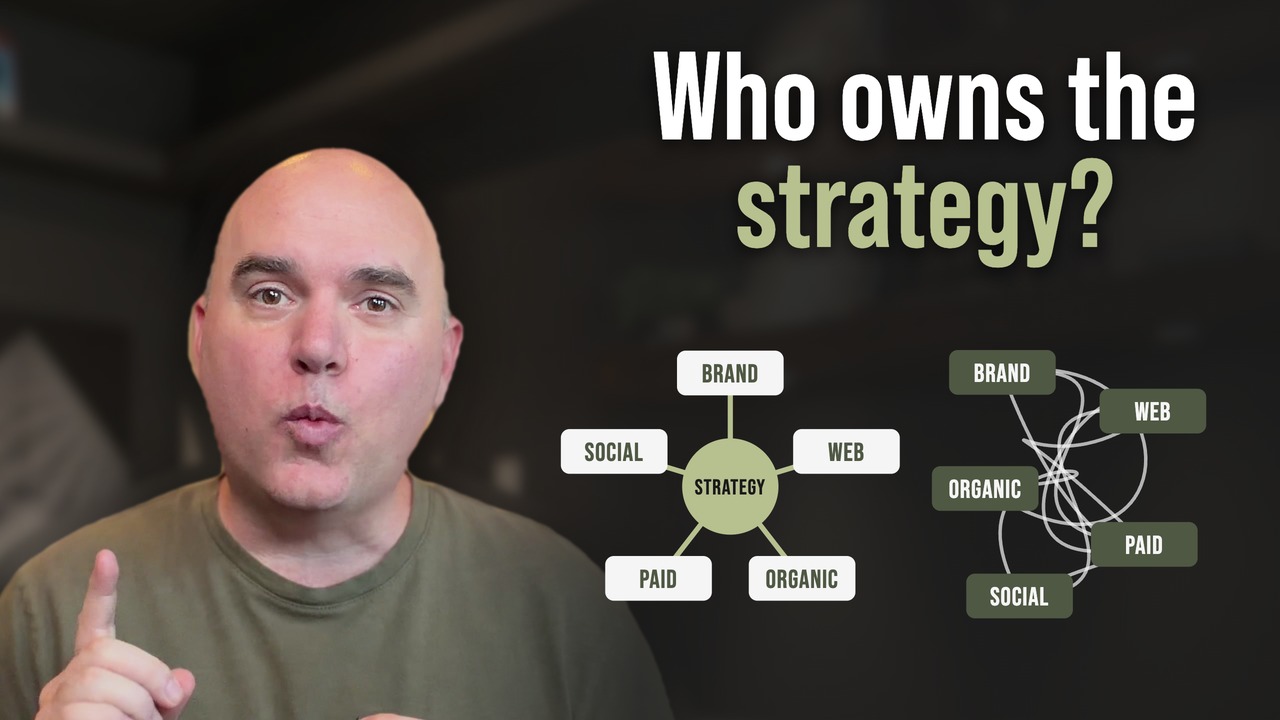
Should you hire one marketing agency to handle everything, or the best specialists you can find for each individual channel? If you have a really strong marketing leader in-house who has the bandwidth, hiring a separate specialist for each piece can work. If you don’t, one capable team with a clear owner of the strategy is probably the path of least resistance. And if someone is already doing great work on one piece, don’t automatically replace them just to cut your vendor count.
I’ve been deeply involved in marketing programs set up both ways. My own agency, Connective Web Design, handles all of it under one roof, so I have a stake in one side of this question, and you should read the case for one team with that in mind. Specialists get a real case below, including where they’re the better choice.
What are you actually deciding?
Before choosing a model, a few questions are worth answering honestly: Who on your side has the time and authority to own the strategy? Where does your marketing need exceptional depth rather than competent execution? Is the problem the individual vendors, or the gaps between them? And which good work would you risk losing by switching? Whoever leads the strategy, keep the final say on objectives, budgets and vendor changes inside the company.
Whether you frame it as a full-service agency versus specialists or as one team versus several, it’s two decisions: who owns the overarching strategy that governs every channel, and who executes each piece of it. You can answer them very differently. An in-house leader can own the strategy and coordinate outside vendors, or an agency can own it along with the work.
For the execution, competence comes first. A specialist may well beat another individual at the one thing they do, but a company is different, because an agency can be a whole team of specialists working from the same playbook. Where it breaks is when someone with real depth in one channel gets handed another they aren’t strong in.
Once those are settled, a third job is easy to leave unassigned: making sure everyone sticks to the plan and learns from each other’s wins. Inside one agency, internal meetings carry a lot of it. With separate specialists, it lands on whoever owns the strategy. Either way, somebody has to own it, or a test that just won in paid search, or a new objection your sales team heard this week, dies in transit.
Who should own the strategy?
Your overall go-to-market strategy is probably the most consequential decision you’ll make, because every tactic has to point back to it. So it should belong to whoever is strongest at it, wherever they sit.
That person doesn’t need to have run every channel, but they do need enough depth to judge the specialists’ work. A growth leader who came up through sales may understand marketing well enough and still not have put in their ten thousand hours. If they can’t tell whether the specialists are doing good work, they can’t tell whether the pieces fit together, and owning the strategy turns into nobody owning it.
A good strategy owner keeps checking whether each channel tracks back to a North Star that’s concrete, like profitable revenue growth or qualified pipeline, and that the channel measures don’t pull the teams in different directions. Without that person, you get specialists working in their own bubbles, not connecting what they do to the goals.
Where they sit changes what you get. An in-house leader is plugged into the day-to-day and sees incremental wins nobody outside would, and an experienced one can coordinate vendors fine; the questions are bandwidth and whether this is really their whole job. Whether that seat should be a full-time hire or a fractional one is its own decision, and here’s how I’d make it. An outside owner can be pulled into your internal communication so the walls come down a bit, and an outside advisor isn’t tied to any vendor, in theory, so they can be a bit more objective. That’s work I do through this site, and since I also own an agency, weigh that “in theory” accordingly. An agency has a structural head start on connecting the channels, because its specialists share managers, systems and meetings, though whether that turns into better work depends on how it actually operates. It may also be defending its own revenue, so you need one you truly believe is in it for the long-term relationship rather than its own short-term gains.
A website rebuild shows what happens when nobody holds this seat. Positioning and search data should shape a site’s structure, down to the words in its URLs, and pages that already rank shouldn’t get wiped out. I recently talked with a company that had put a huge effort into rebuilding its website in-house on a proprietary system, and it was clear to me marketing hadn’t been a consideration. The URL structure was completely flat, with URL variables everywhere. From the way they’d set up their products, I could see they were going to have huge duplicate content issues. And the system was built around a few internal people, which would make it really hard for outside vendors to work on. My prediction is a lot of rework, and it traces back to nobody owning the overall strategy or where the website fits into it.
How does a full-service agency compare with specialists?
Each of the three fits a different situation, and each still needs a clear strategy owner.
| Setup | Best fit | Main advantage | Main risk | Who has to own the strategy |
|---|---|---|---|---|
| One agency for everything | No strong in-house marketing leader with time to coordinate | Speed. Knowledge moves faster, with less coordination overhead | Everything sits with one company, which is very disruptive to replace if it underperforms. It may be defending its own revenue | A named owner: the agency, if you trust it’s in it for the long term, or someone on your side |
| Separate specialists | A strong in-house leader with bandwidth, one affordable channel while you hold the strategy, or a need for unusual depth | Depth where you need it. Easier to compare on price, and one can be replaced without stopping the rest | You absorb the coordination: more meetings, more checking from the top, news spread across separate emails and calls | You or your in-house leader, with the depth to judge each specialist |
| A mix: an agency plus a strong in-house team, or keeping a great specialist | In-house people already at the agency’s own standard, or a specialist already doing great work | You keep what works, and both teams operate as one unit | Judging your own people less objectively than a vendor | Whoever is strongest at it, wherever they sit |
When do specialists win?
When they’re so much better at what they do that all the cross-pollination in the world won’t make up the difference. And the comparison can just as easily be one agency against another, or one in-house person against another. It comes down to performance against your goals.
Specialists also win in more ordinary situations:
- You only need, or can only afford, one channel, and you’re going to hold the strategy yourself.
- You need unusual depth and expertise in one particular channel.
- You don’t want one agency holding the keys to absolutely everything.
- A specialist you already work with is objectively doing great work, so there’s no compelling reason to replace them.
Would a great marketing leader running a team of specialists beat a mediocre integrated agency? I’d say yes, absolutely. The most consequential things are the strategy, sticking to it, and knowing when to pivot. And an agency that calls itself integrated, with no visible proof of how it ties its channels together, is really no better than a set of separate specialists.
A mix can work too. One setup I’ve seen work great is a really solid agency alongside a genuinely talented in-house team, both working as one unit, with the in-house leaders judging their own people as objectively as they would any vendor.
When does one team win?
When there’s no strong in-house leader with time to coordinate everyone, and the agency is genuinely good at every piece it does. Then having everything under one roof has a real advantage, and it’s speed. Knowledge moves faster.
Separate vendors can be made to share dashboards, Slack channels and meetings, but you’re swimming upstream a little, because someone has to set that up on purpose and keep pushing for it. Under one roof, people end up in the same meetings. They see what’s happening in other channels, and they sometimes cover for each other, which hands everyone ideas for their own channel. That doesn’t make it automatic, and plenty of agencies work in silos. The setup just makes it a lot easier.
It can also compound, as long as the teams test what actually transfers: what you learn in month one makes month two run more efficiently.
What does it look like when the channels learn from each other?
Three examples show what that speed is worth, and what it takes to get it.
One test, four teams
Say a well-run split test on a paid search landing page produces a reliable lift in qualified leads. Is there anything your main website can learn from the winner? Maybe there’s language in it your content team or your organic social team can use. That’s one expensive finding that could make four teams run better, and asking those questions is the strategy owner’s job. Just check that the winner brought in qualified leads, not only clicks.
One objection, five places
Every team working on your marketing needs the same picture before pen hits paper: who’s involved in the buying decision, their biggest objections, how you’re different from your major competitors, and how your customers define success. With separate vendors, you can end up explaining it as many times as you have vendors.
Now follow one item, a buyer’s objection:
- your content team answers it in an FAQ and maybe a blog post
- your social team puts it in a carousel
- your paid social team makes videos that speak to it directly
- paid search tweaks a headline to address it head-on
- branding revisits your positioning to see whether anything needs to change
Good research alone doesn’t mean you need one team. What matters is whether the objection reaches everybody. When the teams share meetings and one system, it travels quickly. With separate vendors it arrives in separate emails, calls and calendars, some act on it and some don’t, and who’s checking that everyone is telling the same story? When it works, every channel draws on the same understanding of the objection and answers it in the way that fits its audience.
The client journal
This is how my own agency does it. We keep what we call a client journal, updated after every meeting with the notes and next steps, plus weekly updates from every channel on the wins, the losses and the activities performed. Every specialist reads across channels to benefit from what the others are learning, and in an internal sync led by the strategy owner, every channel can walk out with to-dos for something that worked yesterday.
What does each setup really cost?
One agency can mean less coordination overhead. Separate specialists can be easier to compare on price, but you absorb the coordination yourself, and that’s real work. The friction is higher, though for a strong in-house leader it may be worth the price of admission. Expect more cross-team meetings that may not be covered in anyone’s retainer, and more checking from the top down instead of things surfacing on their own.
Then there’s the cost of changing your mind. Replacing one agency that’s underperforming across the board is super disruptive. Replace one specialist and the rest of the engine keeps moving.
How do you know the setup is working?
Whatever the mix of vendors, judge it by the numbers and the KPIs, all the more when your buyers see you in several channels before they decide. You can also feel it. There’s a visible thread running through every channel, or there isn’t. Is your email campaign tying into a win that just happened in paid search? When sales learns something, does the rest of the team act on it? Or is every team checking the boxes on its monthly deliverables?
What should you ask before you hire an agency or a set of specialists?
Whoever you’re considering, these are the questions I’d ask.
- Who’s actually doing the work? Will I deal with them directly, or through a go-between? What’s their background, and what results have they gotten in the past?
- If we sign up for several channels, what flexibility is there to move budget from one to another if one isn’t working? And if you think the budget shouldn’t move, how would you justify it?
- How do you keep every channel rowing in the same direction? For example, what would you expect paid search to teach organic, and the other way around?
- How do the channels work as one program? Is every channel expected to fill the pipeline, or do some play a supporting role? How do you set goals for each one?
- Give me an example of a time one channel’s learning informed another’s. Who owned that decision, and what changed?
Whether it’s one company or several, I’d add four more:
- When two channels disagree, who makes the final call?
- How will you measure results across channels, not only inside each one?
- Which accounts, data and logins will we own and control?
- If we replace one part of this later, what happens to the rest?
Before you hire anyone
Get clear on three jobs: who owns the strategy, who does the work in each channel, and who makes sure everyone sticks to the plan and learns from everyone else’s wins. Get those right and either setup can get you the results you’re after.
If the gap is the first one and nobody owns the strategy right now, that’s the seat my fractional CMO work fills. If you’re choosing between agencies or specialists, this is how I run an agency search. Or tell me what you’re weighing.
If one agency runs everything, what should stay in your name?
Your website, your analytics and every account the work runs through, with the agency given access you can take away whenever you want. Make sure the contract also covers the working files, reporting and documentation you’d need to hand the work to someone else. That way, if it stops working out, you can move on without losing what’s yours.